Kata Bella Logo

Asia

A Guide to Doi Suthep Temple, Chiang Mai: 4 Things to Know
29 Jan 2026 by Bella

A Guide to Doi Suthep Temple, Chiang Mai: 4 Things to Know Image

I’ve been in Chiang Mai, Thailand for two weeks at the time I’m writing this, and I already feel at home. So much so that I haven’t really explored much yet. I’ve fallen into a nice routine of jiu jitsu training and working from home – which I absolutely love.

So when my two best friends decided to visit, it felt like the perfect time for a proper weekend adventure. At the top of my list was Wat Phra That Doi Suthep, one of Chiang Mai’s most sacred temples. Located on Doi Suthep mountain, it overlooks the city and it’s only 45 minutes drive from the city centre. Known for its golden pagoda, beautiful view, and the famous 306-step dragon staircase, it’s one of those places that feels both grounding and magical.

First Thing First: How to Get to Doi Suthep

After researching how to get there (the options are a private car, public transport from Chiang Mai Zoo, or a Grab car), we decided to just book a Grab car so we could head up early. And by early, I mean 7am – which, by the way, was a huge achievement for the three of us, considering we love a good sleep-in. I read that the sunrise from the viewpoint is amazing, but let’s not push it right? 7am felt ambitious enough, lol. One thing about taking a Grab car up there: some drivers might be a bit hesitant as they might struggle to find passengers on the way back down. In our case, the driver just asked if we could pay cash instead, which was absolutely fine. 

You may also like this article: Swapping Beaches for Mountaintops: A Chilly Christmas in Bromo
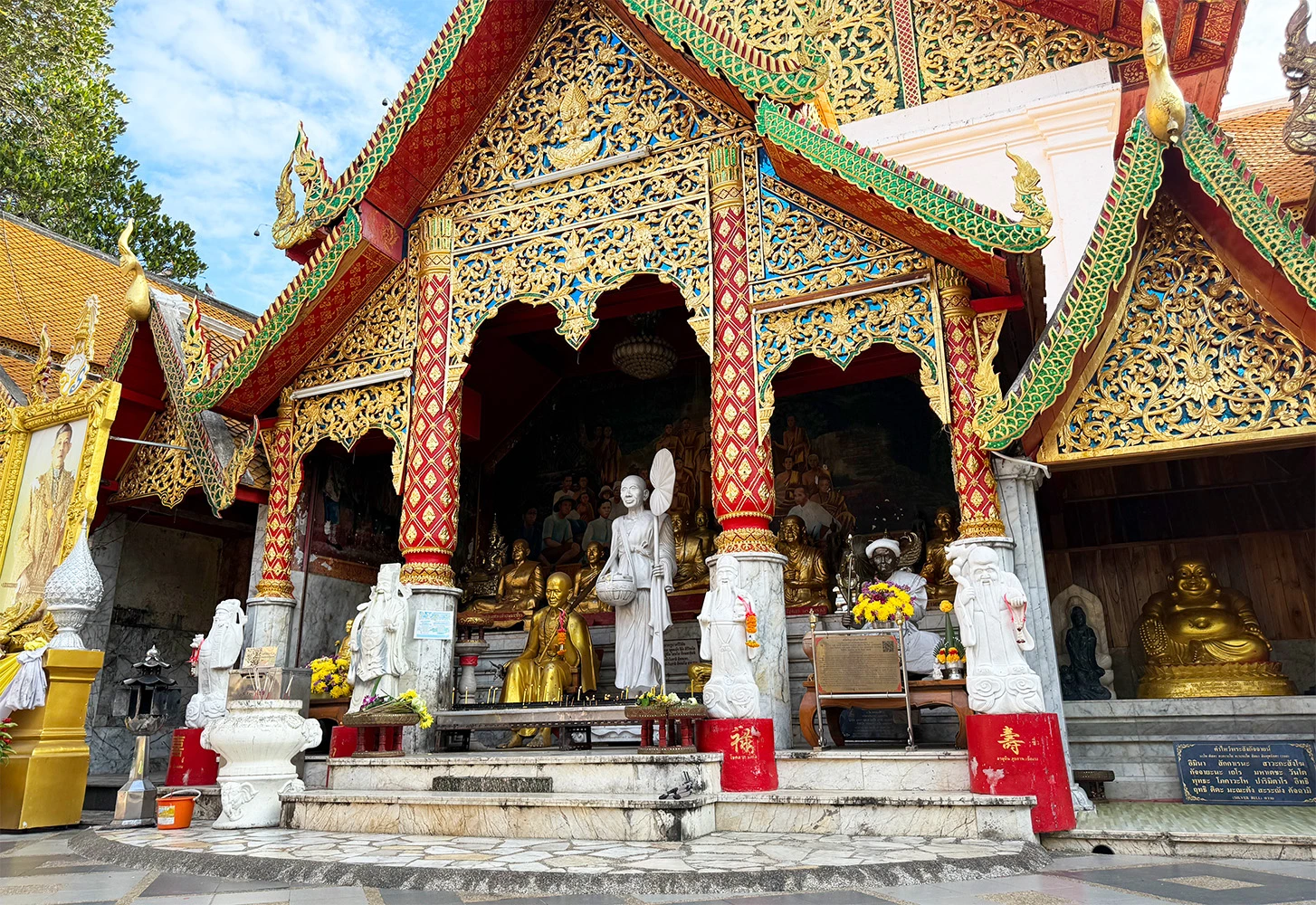
Outside the temples at Doi Suthep

Outside of the temples – people often pray here too

The drive up the mountain didn’t feel long at all, especially with good company. Once we reached the foot of the mountain, the road began winding upwards. On the way up, we passed keen runners and determined cyclists. There’s also the Monk’s Trail if you fancy a hike up, which is popular among locals and hikers looking for a more challenging route to the top. Distance-wise, it’s only around 10km from the city. Technically, I could run to Doi Suthep… but my poor knees would never survive the elevation! Haha. We were dropped off right at the temple entrance, where loads of songthaews (Thai public transport vehicles) were parked. That instantly allayed my worries after all the earlier stress about whether we’d be able to find a Grab car back down. 

Getting to the Top: Stairs or Cable Car?

Okay, so there are two ways to get to the top: the famous 306-step dragon staircase or the cable car. With a little bit of persuasion, I managed to convince the girls that the stairs were the right choice! It’s totally up to you if you want to take the cable car, but there’s usually a queue. The morning air is pretty chilly too, which makes a huge difference. Climbing the stairs when you’re not hot and drenched in sweat is way more pleasant. So yeah… give it a try 😉
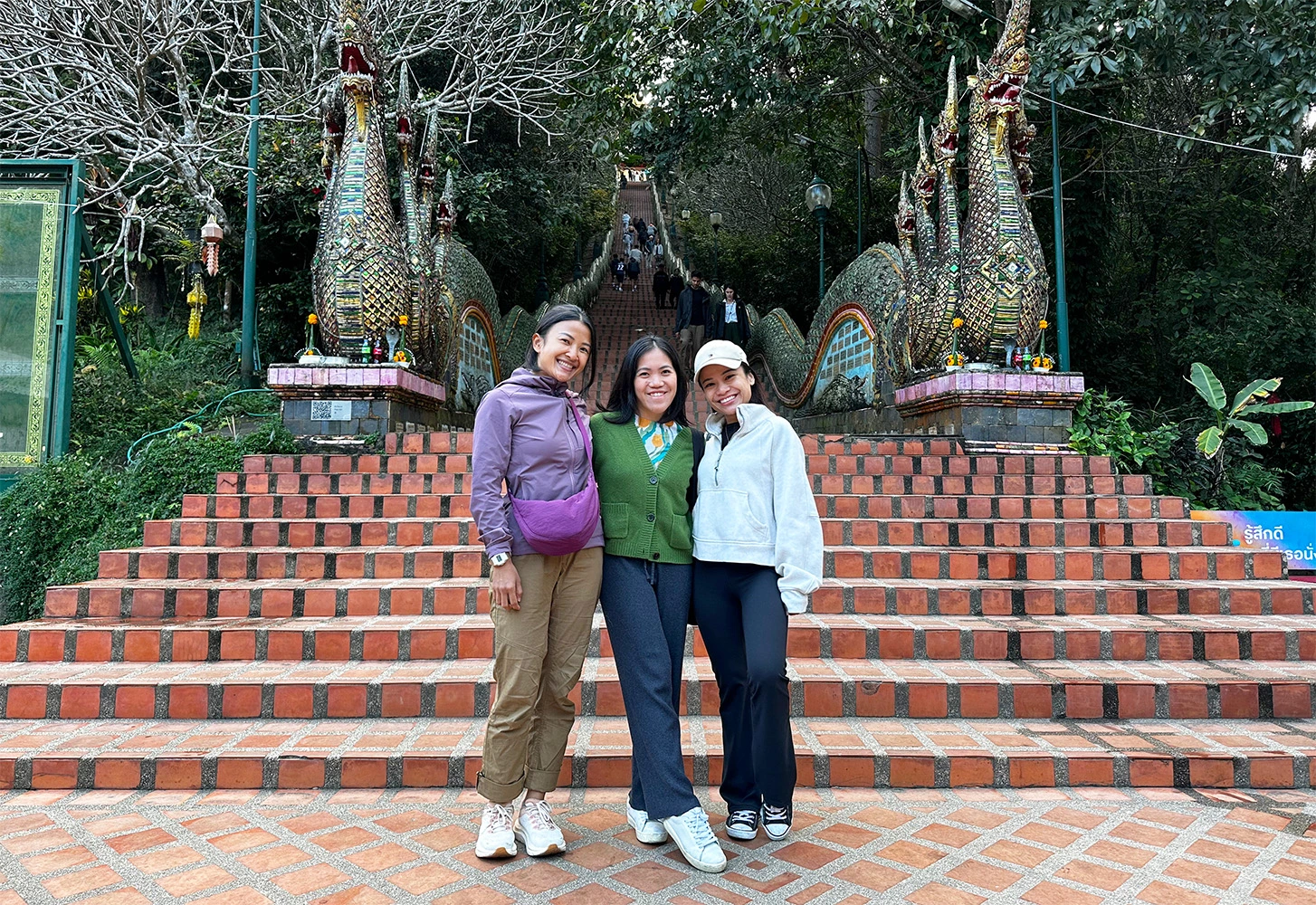
Me and my best friends in front of Doi Suthep’s famous 306-step dragon staircase

Temples, Rituals, and Quiet Moments

Once we made it to the top, there are several temples you can to visit. Just a few things to keep in mind: wear respectful clothing; no tank tops, no shorts, and no shoes inside the temples. You’ll find shoe racks by the entrance where you can safely leave them. Within the temple areas, keep your voice low and your movements calm. You’ll often see people circling the pagoda clockwise three times, and you’re welcome to join in. There’s also a prayer you can recite to worship the pagoda.

There are prayer rooms you can walk into as well, and you’re free to pray in whatever belief you hold. I believe gratitude and blessings exist in every religion, so I visited a few of the prayer rooms with my friends – it felt very soothing. And if praying or rituals aren’t your thing, you can simply wander around and admire the beautiful Buddhist architecture. Once you’re done, take some time to soak in the view of Chiang Mai from the viewing point before heading back down.

Oh, one interesting thing I found in one of the prayer rooms – which I later read that it is actually a fortune-telling area, is that you can step in and say a personal prayer, whether it’s about life, love, decisions, or anything. Once you’re done, you shake a bamboo cylinder provided there until a numbered stick falls out. That number is considered your sign. You then match it to a paper on the wall that you can take, with a written fortune. People usually make a small donation afterwards.

You may also like this article: 48 Hours in Amsterdam: A Quick Trip, Big Memories
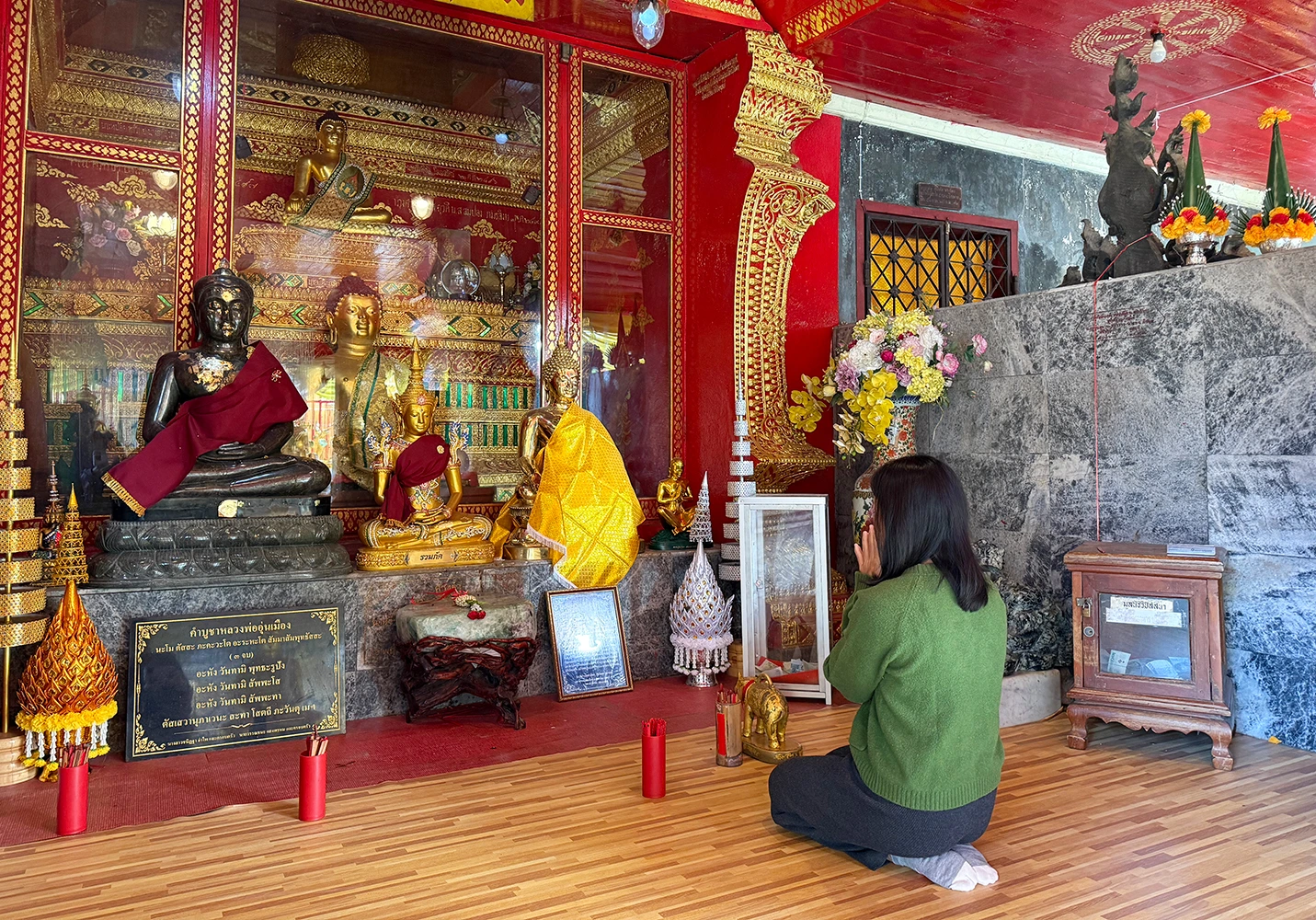
My friend Jessica in the fortune-telling area

A 50-Baht Ride Down The Mountain

We wrapped up our trip with coffee at one of the local food stalls near the dragon staircase. We sat outside on the balcony, watching songthaews line up to head off to different destinations. We then decided to stop by the closest national park, which I’ll cover in the next article. By the way, a one-way songthaew ride to the national park (it’s close enough to the city) costs just 50 baht! Super affordable and so much fun. We shared the ride with other travellers – an experience I hadn’t had in years. 
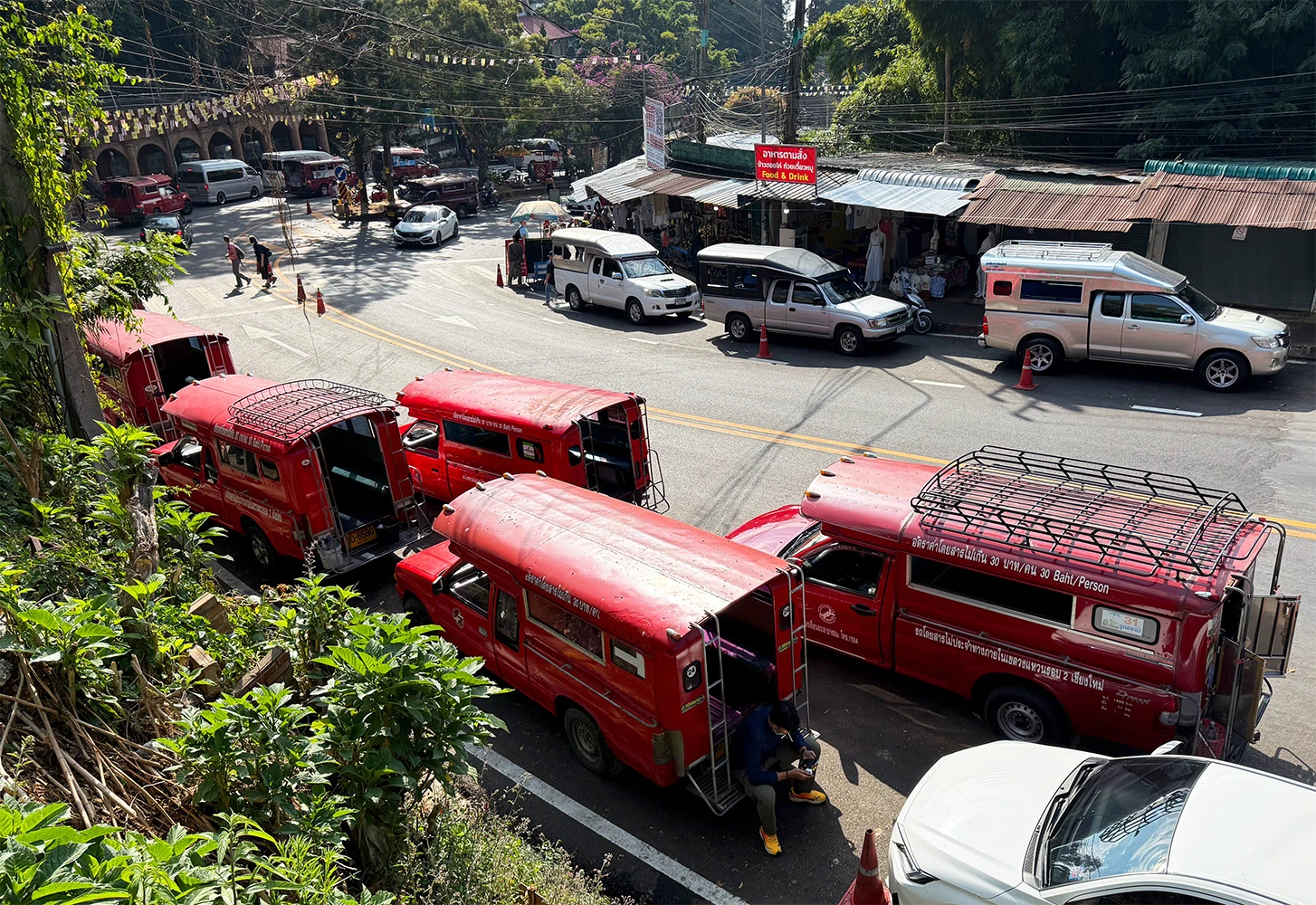
The iconic red songthaew (Thai public transport vehicle) lining up by the entrance of Doi Suthep

Anyway, that’s my Doi Suthep adventure with my girls. Hope you found some useful tips if you’re planning a trip there or to Chiang Mai in general. I’ll be in this beautiful city for a while, so expect more articles on other spots, restaurants, events, and whatnot. Stay tuned on www.kata-bella.com and follow us on Instagram @katabellamag.

Planning your trip to Doi Suthep

  • Opening hours: Daily, 6am – 6pm
  • 🌅 Best time to visit: Sunrise or sunset for the magical views
  • 📍Location: Around 10 – 13 km from the city centre, on Doi Suthep Mountain
  • 🎟️ Entrance fee: 50 baht for foreign visitors (for temple maintance)
  • 🚘 Transportation: Grab car, songthaew, private car, or a mountain bike! 😉
  • 🚶🏼 Access to the temple: Stairs or cable car
  • 👗 Dress code: Clothing that covers shoulders and knees
  • 🚽 Toilets: Available downstairs near the cable car entrance (they’re clean!)

Personal tips:

  • Get there as early as you can – the weather is cool in the morning and there are fewer people.
  • Try the fortune-telling area and do the pagoda loop for the full experience.
  • Go to the toilet before heading up and bring a water bottle. It gets really hot once the sun comes out.
You might also want to read

Brazil and Indonesia: Fun Finds in Similarities Image

10 Dec 2024 by Bella in South America

Brazil and Indonesia: Fun Finds in Similarities

Brazil has won my heart twice. I first went there to train Jiu Jitsu because, well... Brazilian Jiu Jitsu. Plus, my former coach lives there, on a charming little island called Florianopolis, just an hour’s flight from São Paulo. So, yes, imagine the journey from Bali! But it was totally worth it.  Anyway, Kata Bella not here to write about my Jiu Jitsu trip, but what really fascinated me was how similar Brazil is to Indonesia. Here are a few interesting things I noticed. Can’t wait to go back soon! The Language I know it’s obvious - because Brazilians speak Portuguese, and Indonesia was colonised by the Portuguese (among others). So, when I first landed at the airport, many words already felt familiar to me. I could pretty much guess their meanings. As I started learning Portuguese, I found it surprisingly easy to memorise the vocabulary because of the similarities. Some words are even the same in Indonesian, just pronounced differently. Here are a few for fun: Mesa (Indonesian: Meja) - Table Manteiga (Indonesian: Mentega) - Butter Festa (Indonesian: Pesta) - Party Janela (Indonesian: Jendela) - Window Sapato (Indonesian: Sepatu) - Shoes Igreja (Indonesian: Gereja) - Church Escola (Indonesian: Sekolah) - School  The Snacks I have this habit of exploring supermarkets when I travel overseas because I love discovering products we don’t have back home. And there was one aisle in Hyperbom that instantly took me back to my childhood days in Java - basically, it was filled with traditional snacks from Java, but in Brazilian versions. Paçoca vs Enting Enting (Caramelised peanuts pressed into bite-sized bars) Flocos de Arroz vs Jipang (Puffed rice coated in sweet syrup) Pé de Moleque vs Ampyang (Roasted peanuts in caramelised sugar) Cocada com Açúcar Mascavo vs Kembang Gula Kelapa (Candied shredded coconut) Geladinho vs Es Lilin (Ice lollies) Speaking of childhood snacks, I also found Trakinas, those chocolate sandwich snacks I haven’t seen in Indonesia since the 90s! That was definitely one of the highlights of my trip. Alright, that’s all for now about Brazil! I’ve got more to share from another trip, but I’ll save it maybe for Part 2. Tchau tchau!

A Day Trip to Chiang Rai: 5 Beautiful Destinations to See Image

05 Apr 2026 by Bella in Asia

A Day Trip to Chiang Rai: 5 Beautiful Destinations to See

Chiang Rai is a city in northern Thailand, near the borders of Laos and Myanmar, about a few hours’ drive from Chiang Mai. It’s home to several beautiful temples and tourist spots you’ve probably seen advertised by tour agencies. While my parents were visiting Chiang Mai, I decided to take them on a little road trip to Chiang Rai. We wanted something chill, so instead of joining a tour, we booked a private car with a driver and set off early in the morning to spend the day without feeling rushed. These were the places we managed to visit. Long Neck VillageWhite TempleBlue TempleBig BuddhaSingha Park You may also like this article: How to Stay in Thailand Visa-Free for 90 Days Long Neck Village We left Chiang Mai around 7am, and about an hour later we had already arrived at the Long Neck Village. By the way, this isn’t their original indigenous village - it’s a tourist site created to introduce visitors to the Kayan tribe. If you’re interested in learning more deeply about the tribe and their way of life, it’s also possible to visit their actual village with a local guide. The Kayan Long Neck tribe is an ethnic group originally from Myanmar - so they’re not native to Thailand, if I understand correctly. Many migrated across the border seeking safety as refugees, and unfortunately, many still don’t have full legal status in Thailand, which can mean limited access to education and healthcare. I can see why some people might view this tourist village as controversial. Personally, I felt that visiting, paying the entrance fee and supporting them by buying the handmade crafts and souvenirs they sell - was a small way to contribute directly to their community. I genuinely hope their culture continues to exist and be preserved. White Temple This temple is just as beautiful as it looks on the internet - maybe even more. The entire complex is pure white, covered in incredibly detailed mirror ornaments that sparkle under the sun. I read that it was designed and built by Thai artist Chalermchai Kositpipat. The white colour represents the purity of Buddha, while the mirror fragments reflecting the sunlight symbolise Buddha’s wisdom. To enter the temple, you walk across a bridge with a lake of tormented hand statues reaching up from below, along with eerie figures symbolising human desire, greed, and suffering. A voice announcement asks visitors to keep moving and not stop on the bridge, representing the idea of leaving darkness behind. At the centre is the main hall, where photography isn’t allowed. Inside, a large Buddha sits surrounded by murals featuring pop-culture characters like Superman, Spider-Man, and Pokémon - not random at all, it is a portrayal of the modern world and the things people become obsessed with today; technology, consumerism, power, and fame. You could easily spend hours exploring this temple - it’s huge! But I’d recommend going in the morning. Not only does it get very hot by midday, it also becomes extremely busy with visitors. P.S. They have one of the most beautiful toilets I’ve ever seen. You may also like this article: A Guide to Doi Suthep Temple, Chiang Mai - 4 Things to Know Blue Temple Located only about 10 minutes from the White Temple, is the Blue Temple. It was designed by Phutta Kabkaew, a student of Chalermchai Kositpipat - the artist behind the White Temple. Dominated by vibrant blue with a touch of gold, the temple carries a similar artistic style, but here the colour blue represents Buddha’s infinite wisdom. The temple is also known as the “Temple of the Dancing Tiger.” Legend says that villagers once saw tigers roaming and leaping around the temple grounds many years ago. Visitors are allowed to enter and take photos inside the prayer hall, where a giant white porcelain Buddha sits beautifully at the centre, making it a striking space to admire. Big Buddha One last stop before heading back to Chiang Mai was the Big Buddha. Sitting atop a hill surrounded by greenery is a giant statue of Guan Yin - or Indonesians may know her better as Dewi Kuam Im, the Goddess of mercy and compassion. You can spot the statue from far away, but the closer you get, the more impressive (and of course, the bigger) it becomes. Unlike the White and Blue Temples, the Big Buddha feels much calmer and less crowded. It’s believed that praying here brings good health and fortune. Personally, I’ve always seen Dewi Kuam Im as a powerful symbol of compassion and I do believe in kindness and positive energy. Singha Park We originally planned to stop by Singha Park because there was a hot air balloon festival happening that very day. Since the park is on the way back to Chiang Mai anyway, we thought - why not? We arrived around 6pm, which I assumed would be the perfect time to catch the show, but unfortunately it turned out the balloons were scheduled to launch much later. We also had to take a shared songthaew ride to reach the lake where the festival was taking place. Because we hadn’t planned to stay overnight in Chiang Rai and didn’t have any accommodation booked, we eventually decided to head back home instead. The park itself was lovely, though and definitely worth adding to your list. It would’ve been nice to see the hot air balloon festival, which is apparently a big annual event with participants from all over the world. Oh well - next time 🙂 Image credit: Chiang Rai Balloon Fiesta Even though it was just a day trip, Chiang Rai felt quite different from Chiang Mai - quieter and full of little surprises (literally, like when we stopped for lunch and the restaurant owner realised we were Indonesian and told us he had visited Medan 20 years ago, haha!). We managed to see a lot in one day, but there are still plenty of places left on the list, like the Black House Museum (Baan Dam) and other lesser-known temples and viewpoints scattered around the region. Maybe that’s a good reason to come back. Chiang Rai feels like a place best explored slowly, and next time, I’d probably stay a night or two to really experience it properly (and hopefully watch the hot air balloon festival!).

Where to Eat in Sydney: 5 Spots I’ll Always Go Back to Image

16 Feb 2026 by Bella in Australia

Where to Eat in Sydney: 5 Spots I’ll Always Go Back to

Where to eat in Sydney - Every time I’m back in this beautiful city, one thing is guaranteed: I plan my days around food (other than hanging out with my family and friends, of course! hehe). From local restaurants, global chains, to comforting desserts, these are some of my personal favourites - the ones I genuinely crave, talk about, and immediately recommend to friends. The Grounds Coffee FactoryNando’s Peri Peri ChickenIsland RadioTenacious BakehouseYogurberry The Grounds Coffee Factory I know The Grounds of Alexandria is on pretty much everyone’s must-visit list when in Sydney. And yes, their art installations (which change every few months) are always impressive. But did you know there are other The Grounds locations too? And they’re just as special, with genuinely good food. My cousins took me to the one in Eveleigh, an area that was once a major locomotive and railway hub back in the late 19th century. This branch is an actual coffee factory, so while you’re eating, you can see (and smell!) the coffee being crafted through the glass windows. If you want to enjoy The Grounds’ great food without the long queues, this one’s definitely worth a visit. Image credit: The Grounds Coffee Factory Instagram You may also like this article: A Playful Stay in Copenhagen: My 25hours Hotel Experience Nando’s Peri Peri Chicken For those who have been touched by the deliciousness of Nando’s peri-peri chicken, let’s hug and agree it’s one of the best things to eat in the world. And if you’ve never tried it before, imagine this: tender, charred, flame-grilled chicken marinated in a spicy, tangy peri-peri sauce. Depending on the heat level, the spice builds into a warm, zesty kick rather than a burn-your-mouth moment. The flavour goes all the way to the bone. Pair it with peri-peri-sprinkled chips or corn on the cob and boom - you’ve got the kind of meal you find yourself craving again and again. Nando’s is a global chain and I’ve tried it in a few other countries, but in my personal experience, Nando’s in Oz is the best. Image credit: Nando's Australia website Island Radio “You can take a girl out of Asia, but you can’t take Asia out of a girl” - I guess that saying is true. As much as I love international cuisine, Asian food wins every time. No competition needed. This trendy spot in Redfern serves up a South-East Asian–inspired menu. They change their menu every now and then, by the way, which keeps things exciting - but this is what we had: sate Padang (Padang beef satay), grilled chicken, quinoa salad, their take on mie ayam (chicken noodles), and a Balinese pie susu (milk pie) for dessert. Nothing disappointed. The Indonesian dishes still had spot-on flavours, even with a modern twist - and I have to admit, their pie susu was actually better than the OG, whoops! Bonus points: they have a disco toilet. Because no night out is complete without a bathroom rave! What we had at Island Radio - sate padang, mie ayam, and pie susu Tenacious Bakehouse As a dessert person and a lifelong lover of Asian flavours like matcha, taro, and ube - I have to say this, and I’m really not exaggerating: their Taro Cream Croissant is one of the best pastries I’ve ever had. They claim to use natural sweetness with 60% reduced sugar, and I believe it, because it’s not overly sweet like most pastries. The cream somehow tastes rich and light at the same time (how is that even possible??). It’s best eaten cold, which makes the taro cream taste almost like ice cream. That purple dusting on top is sweet potato powder, and it ties everything together perfectly. I’m sure their other pastries are amazing too… but I’ll save those for next time. The star - Taro Cream Croissant and other interesting pastries at Tenacious Bakehouse You may also like this article: Pastries, Passion, and a Little Bit of Magic at Theo’s Wife Lois Yogurberry And another dessert spot...I know you can get frozen yoghurt pretty much anywhere, but going back to my love for Asian flavours, yogurberry has taro froyo! Woot woot! And that alone is why, even with all the newer and trendier frozen yoghurt spots around, Yogurberry is still my favourite. It’s pay-by-weight, so you can customise it exactly how you like.  I usually go for taro froyo topped with their unsweetened mochi, coconut jelly, and almond flakes. Simple, not overly sweet, and deeply comforting. I was so happy to see that even after years of not being back in Sydney, this place still exists. I wish them all the success so they stay open foreverrrr!!! Image credit: Yogurberry Australia Instagram Sydney’s food scene is massive, but these places hit that sweet spot between comfort, flavour, and personal nostalgia for me. Whether you’re visiting for the first time or coming back like I was, I hope this list gives you a few delicious reasons to eat your way through the city.