Kata Bella Logo

Asia

A Guide to Doi Suthep Temple, Chiang Mai: 4 Things to Know
29 Jan 2026 by Bella

A Guide to Doi Suthep Temple, Chiang Mai: 4 Things to Know Image

I’ve been in Chiang Mai, Thailand for two weeks at the time I’m writing this, and I already feel at home. So much so that I haven’t really explored much yet. I’ve fallen into a nice routine of jiu jitsu training and working from home – which I absolutely love.

So when my two best friends decided to visit, it felt like the perfect time for a proper weekend adventure. At the top of my list was Wat Phra That Doi Suthep, one of Chiang Mai’s most sacred temples. Located on Doi Suthep mountain, it overlooks the city and it’s only 45 minutes drive from the city centre. Known for its golden pagoda, beautiful view, and the famous 306-step dragon staircase, it’s one of those places that feels both grounding and magical.

First Thing First: How to Get to Doi Suthep

After researching how to get there (the options are a private car, public transport from Chiang Mai Zoo, or a Grab car), we decided to just book a Grab car so we could head up early. And by early, I mean 7am – which, by the way, was a huge achievement for the three of us, considering we love a good sleep-in. I read that the sunrise from the viewpoint is amazing, but let’s not push it right? 7am felt ambitious enough, lol. One thing about taking a Grab car up there: some drivers might be a bit hesitant as they might struggle to find passengers on the way back down. In our case, the driver just asked if we could pay cash instead, which was absolutely fine. 

You may also like this article: Swapping Beaches for Mountaintops: A Chilly Christmas in Bromo
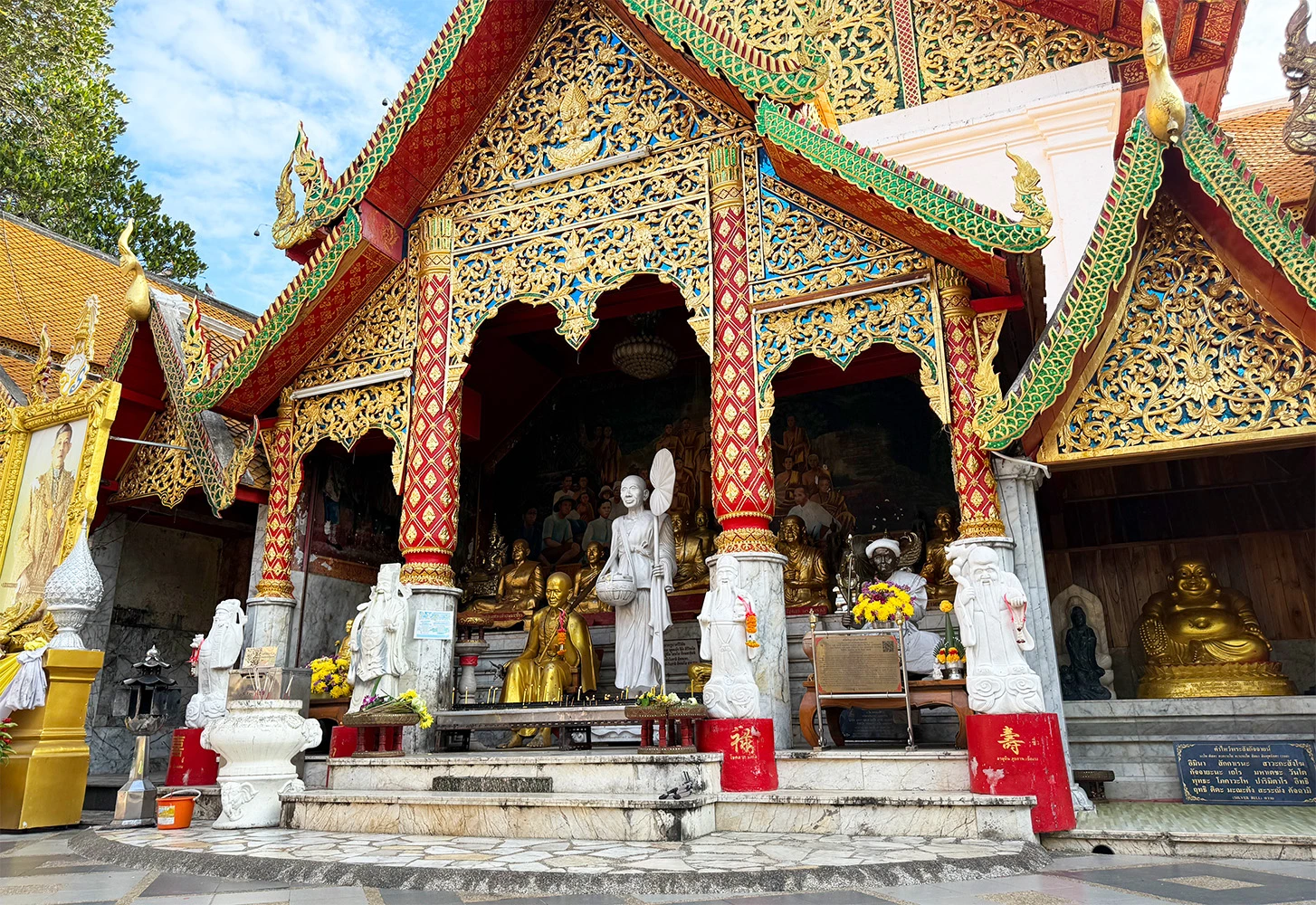
Outside the temples at Doi Suthep

Outside of the temples – people often pray here too

The drive up the mountain didn’t feel long at all, especially with good company. Once we reached the foot of the mountain, the road began winding upwards. On the way up, we passed keen runners and determined cyclists. There’s also the Monk’s Trail if you fancy a hike up, which is popular among locals and hikers looking for a more challenging route to the top. Distance-wise, it’s only around 10km from the city. Technically, I could run to Doi Suthep… but my poor knees would never survive the elevation! Haha. We were dropped off right at the temple entrance, where loads of songthaews (Thai public transport vehicles) were parked. That instantly allayed my worries after all the earlier stress about whether we’d be able to find a Grab car back down. 

Getting to the Top: Stairs or Cable Car?

Okay, so there are two ways to get to the top: the famous 306-step dragon staircase or the cable car. With a little bit of persuasion, I managed to convince the girls that the stairs were the right choice! It’s totally up to you if you want to take the cable car, but there’s usually a queue. The morning air is pretty chilly too, which makes a huge difference. Climbing the stairs when you’re not hot and drenched in sweat is way more pleasant. So yeah… give it a try 😉
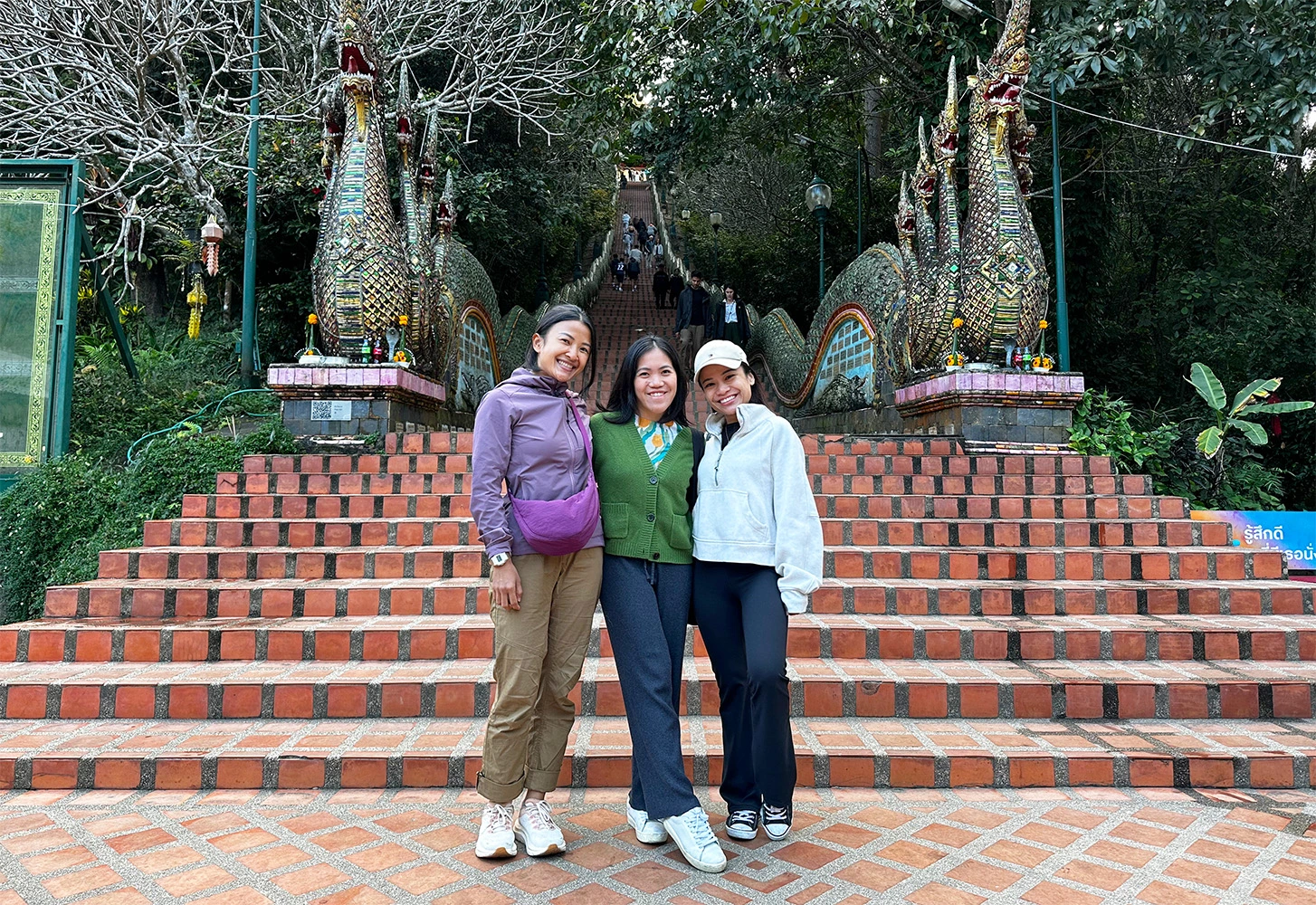
Me and my best friends in front of Doi Suthep’s famous 306-step dragon staircase

Temples, Rituals, and Quiet Moments

Once we made it to the top, there are several temples you can to visit. Just a few things to keep in mind: wear respectful clothing; no tank tops, no shorts, and no shoes inside the temples. You’ll find shoe racks by the entrance where you can safely leave them. Within the temple areas, keep your voice low and your movements calm. You’ll often see people circling the pagoda clockwise three times, and you’re welcome to join in. There’s also a prayer you can recite to worship the pagoda.

There are prayer rooms you can walk into as well, and you’re free to pray in whatever belief you hold. I believe gratitude and blessings exist in every religion, so I visited a few of the prayer rooms with my friends – it felt very soothing. And if praying or rituals aren’t your thing, you can simply wander around and admire the beautiful Buddhist architecture. Once you’re done, take some time to soak in the view of Chiang Mai from the viewing point before heading back down.

Oh, one interesting thing I found in one of the prayer rooms – which I later read that it is actually a fortune-telling area, is that you can step in and say a personal prayer, whether it’s about life, love, decisions, or anything. Once you’re done, you shake a bamboo cylinder provided there until a numbered stick falls out. That number is considered your sign. You then match it to a paper on the wall that you can take, with a written fortune. People usually make a small donation afterwards.

You may also like this article: 48 Hours in Amsterdam: A Quick Trip, Big Memories
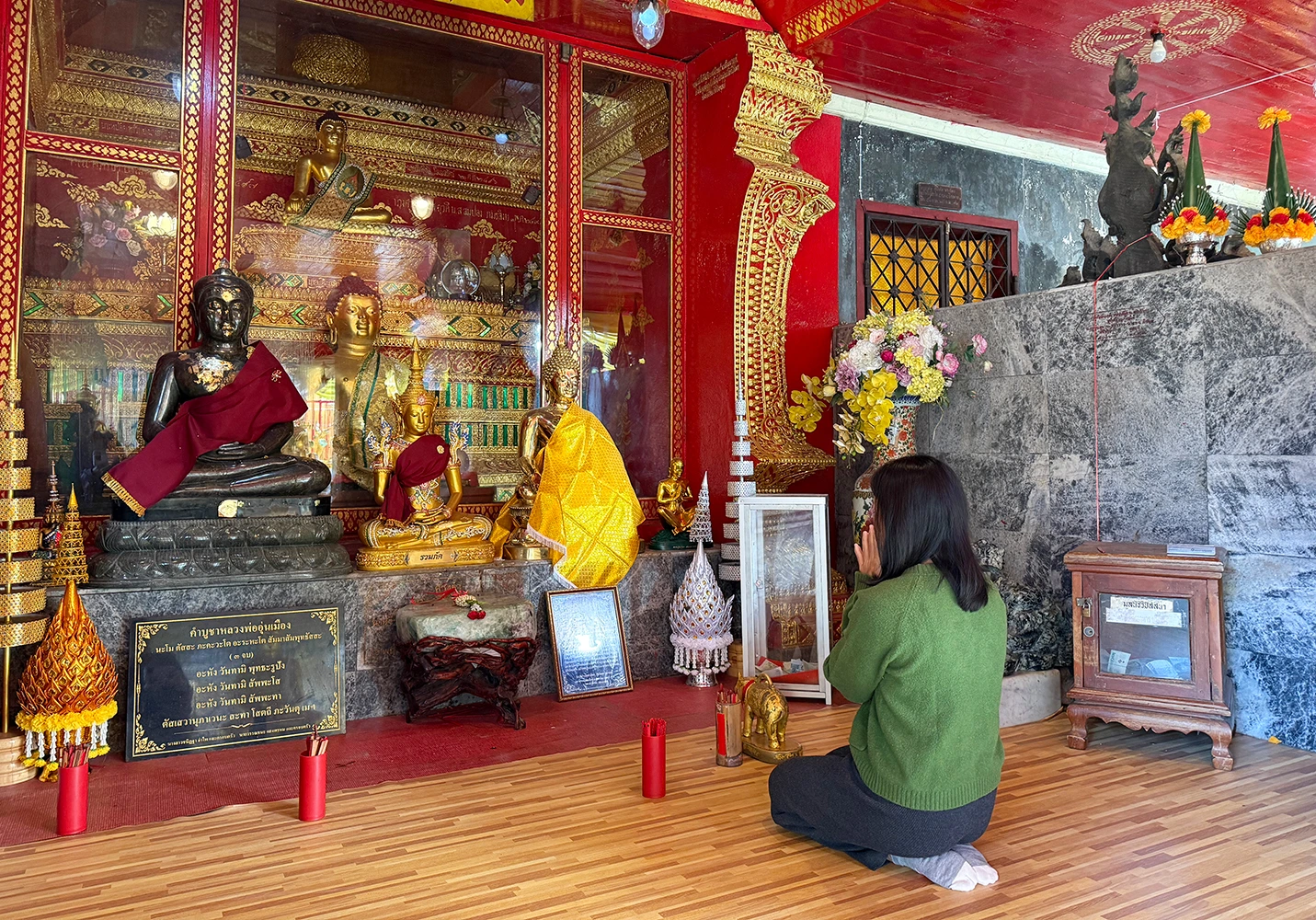
My friend Jessica in the fortune-telling area

A 50-Baht Ride Down The Mountain

We wrapped up our trip with coffee at one of the local food stalls near the dragon staircase. We sat outside on the balcony, watching songthaews line up to head off to different destinations. We then decided to stop by the closest national park, which I’ll cover in the next article. By the way, a one-way songthaew ride to the national park (it’s close enough to the city) costs just 50 baht! Super affordable and so much fun. We shared the ride with other travellers – an experience I hadn’t had in years. 
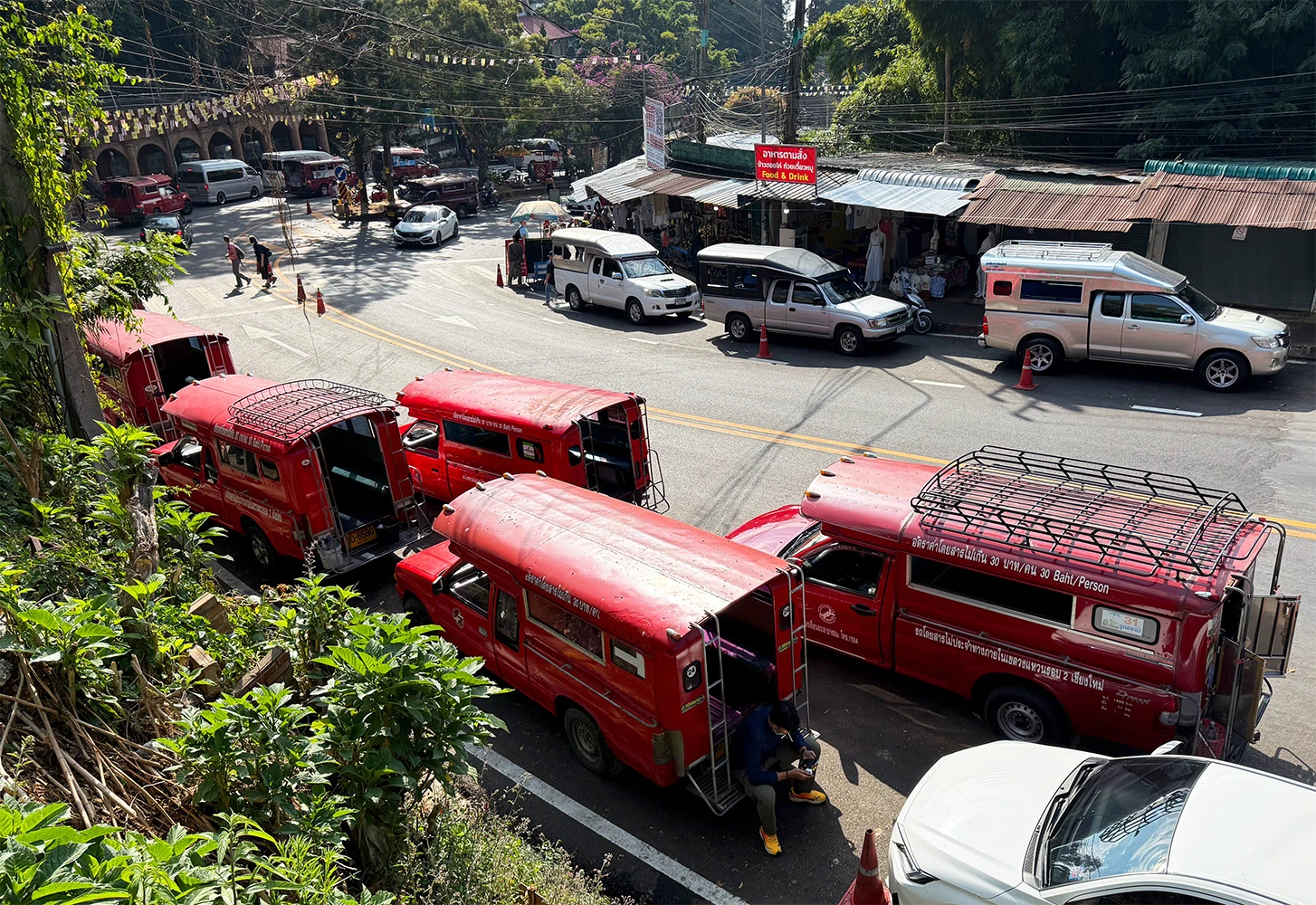
The iconic red songthaew (Thai public transport vehicle) lining up by the entrance of Doi Suthep

Anyway, that’s my Doi Suthep adventure with my girls. Hope you found some useful tips if you’re planning a trip there or to Chiang Mai in general. I’ll be in this beautiful city for a while, so expect more articles on other spots, restaurants, events, and whatnot. Stay tuned on www.kata-bella.com and follow us on Instagram @katabellamag.

Planning your trip to Doi Suthep

  • Opening hours: Daily, 6am – 6pm
  • 🌅 Best time to visit: Sunrise or sunset for the magical views
  • 📍Location: Around 10 – 13 km from the city centre, on Doi Suthep Mountain
  • 🎟️ Entrance fee: 50 baht for foreign visitors (for temple maintance)
  • 🚘 Transportation: Grab car, songthaew, private car, or a mountain bike! 😉
  • 🚶🏼 Access to the temple: Stairs or cable car
  • 👗 Dress code: Clothing that covers shoulders and knees
  • 🚽 Toilets: Available downstairs near the cable car entrance (they’re clean!)

Personal tips:

  • Get there as early as you can – the weather is cool in the morning and there are fewer people.
  • Try the fortune-telling area and do the pagoda loop for the full experience.
  • Go to the toilet before heading up and bring a water bottle. It gets really hot once the sun comes out.
You might also want to read

Japan for First-Timers: How I Accidentally Fell in Love (and Went Back Twice...and Then Again) Image

09 Jun 2026 by Teman Bella in Asia

Japan for First-Timers: How I Accidentally Fell in Love (and Went Back Twice...and Then Again)

JAPAN FOR FIRST-TIMERS - an article by Yohanes Hutauruk It was in 2018 when I visited Japan for the very first time - and not just that, it was also my first ever solo holiday. I had always imagined my first solo trip would be somewhere closer to home in Southeast Asia. Something easy. Something familiar. But somehow, I ended up in Japan - the Land of the Rising Sun, a country so advanced it sometimes feels like it’s already living in 2050. Fast forward to today, I’ve visited Japan three times. People say “third time’s the charm”, but for me, three is just the beginning. This is clearly a relationship that is going to continue. The funny thing is, the trip itself started as a very impulsive decision at a travel fair. I remember standing in line at the counter, not even knowing where I wanted to go and then suddenly...Japan just popped into my head. Cue mild panic. As a first-time solo traveller, I went straight into research mode: where to go, what to eat, how to survive. So if you’re reading this as a first-timer (or a slightly anxious one), consider this your friendly guide from someone who has been exactly where you are. Welcome to Japan. Or as I like to call it: your next obsession. Things You Need Before Entering JapanPlanning Your Trip (a.k.a. Where to Even Start)Getting Around (Without Losing Your Mind)Where to Go in Japan (and Yes, Start with the Mainstream)Slurp Your Way into JapanShibuya: Where Your Wallet Gets TestedThe Famous Shibuya Crossing (Yes, It’s Worth It)Tokyo Disneyland and DisneySea (Choose Wisely… or Don’t)Disneyland vs DisneySea: The Ultimate First-Timer DilemmaTop rides to prioritise:HighlightsWhat to Eat (Because You Will Get Hungry… A Lot)What to Buy (You Don’t Need It… But You Do)Strategy Tip (So You Don’t Spend Your Day in Line)For the Wizards and Witches (YES, YOU!)Konbini - My Three-Times-a-Day (or More) HabitAnd So Much More to Discover You may also like this article: 48 Hours in Amsterdam - A Quick Trip, Big Memories Things You Need Before Entering Japan If you’re an Indonesian passport holder, here’s the good news (and a little bit of admin, but don’t worry - it’s painless). Japan used to require a visa for Indonesians, and while that’s still true for regular passports, things have become much easier for e-passport holders. You can now apply for a visa waiver online, and the process is surprisingly quick - just a few days. If you’re using a regular passport, you’ll still need to apply for a visa, which usually takes around one to two weeks. My advice? Apply at least one to two months before your trip, just to be safe and stress-free. Once your visa (or waiver) is sorted, the next step is completing your customs declaration online. The process is simple, user-friendly, and only takes a few minutes. At the end, you’ll receive a QR code - this will be scanned when you arrive at the airport in Japan. And just like that, you’re already halfway there. I kept going back to Japan to see "family" Planning Your Trip (a.k.a. Where to Even Start) For first-timers, the classic trio is: Tokyo, Kyoto and Osaka. Each city has its own personality: Tokyo is fast-paced, crowded and feels like the future. Kyoto is calm, traditional and beautifully refined. Osaka is lively, friendly and basically heaven for food lovers. Before you arrive, make sure you’ve sorted your transportation from the airport to your hotel. You have two choices: Option one: comfort Book a private airport transfer and glide straight to your hotel door like a well-prepared traveller. Option two: adventure Take public transport like a local. It’s efficient, reliable… and occasionally involves carrying your suitcase up what feels like a never-ending staircase. Not all stations have elevators - consider this your first workout in Japan. Now, let’s talk about hotels. If you’re staying in a budget hotel in Japan, manage your expectations (and maybe your luggage size). Rooms are compact. Very compact. You might not be able to fully open a large suitcase, and closet space is...optimistic at best. But here’s the upside: they are clean, efficient, and almost always come with a bathtub. Yes, a bathtub. Hotels like APA Hotels and Hotel Mystays are great options with multiple locations and reasonable prices - especially if you book early. Just don’t expect a full-sized soaking tub. Most are more like “sit-and-contemplate-your-life” tubs rather than “stretch-and-relax” ones. The good news? Amenities in Japan are excellent. Toiletries are provided and surprisingly high quality. You can skip packing shampoo, soap, and even toothpaste. Japan has you covered - unless you’re very particular about your products. And honestly, if you’re out exploring all day, the room is more than enough. Getting Around (Without Losing Your Mind) If you plan to explore a lot (which you should), I highly recommend getting a Tokyo Metro Pass. It comes in 24, 48, and 72-hour options and covers most metro lines in Tokyo. It’s simple, convenient, and saves you from constantly topping up a card like Suica. Personally, I prefer the pass - unlimited rides, no thinking required. You can buy it online and collect it easily at ticket machines. The process is straightforward and very tourist-friendly. Similar transport systems are available in Kyoto and Osaka, making it easy to get around without blowing your budget. And yes, taxis exist...but unless you’re feeling generous with your wallet, maybe save those for emergencies (like food and more food :)) You may also like this article: Where to Eat in Sydney - 5 Spots I’ll Always Go Back to Where to Go in Japan (and Yes, Start with the Mainstream) For first-timers, here’s my rule: do the touristy things. Seriously. You can be cool and “off the beaten path” on your second, third, or tenth trip. For now, just enjoy the classics - they’re famous for a reason. Slurp Your Way into Japan Start with something simple but essential: ramen. And not just any ramen - go to Ichiran Ramen. This place is perfect for solo travellers. Actually, it was made for us. You sit in your own little booth, fill out your ramen preferences (yes, you can customise everything), and order from a vending machine. Extra egg? Add it. More pork? Of course. Seaweed? Why not. The best part? You don’t even have to talk to anyone. Your bowl magically appears through a small curtain like a ramen surprise. Minimal interaction, maximum satisfaction. Perfect for introverts. Or for people who just don’t want to socialise before coffee. Ichiran Ramen, the perfect stop for solo travellers Shibuya: Where Your Wallet Gets Tested Next stop: Shibuya - also known as your new shopping problem. Here’s one important tip from someone who learned the hard way: don’t overpack. Just buy your clothes in Japan. Head straight to Uniqlo or GU (yes, it’s pronounced G-U). They literally have everything: undies, basics, jackets, shoes, accessories, even winter wear - all at dangerously affordable prices. And I mean dangerously. Because what starts as “I’ll just get one jacket” quickly turns into “how did I spend half my budget on Day 2?” Be strong. Or don’t. Your choice. And for sneaker lovers - you are in serious trouble (in a good way). You’ll find plenty of ABC-Mart stores around Shibuya. Think of it as sneaker heaven: rows and rows of Nike, Adidas, New Balance, and more - often at very reasonable prices compared to back home. So yes...maybe leave some extra space in your luggage. You’ve been warned. The good news? These stores are everywhere across Japan, so you’ll never run out of options - or excuses. ABC Mart, one of the many "dangerous" places The Famous Shibuya Crossing (Yes, It’s Worth It) Right in the middle of Shibuya is the iconic Shibuya Crossing - one of the busiest crossings in the world. You have two ways to enjoy it: Option 1 Be part of the chaos. Cross with everyone, take your content, feel the energy. Just… don’t stop in the middle like a confused tourist. Keep walking. Option 2 Watch from above like a calm, evolved traveller. Here are some of the best viewpoints: Mag’s Park (Magnet by Shibuya 109 rooftop): great direct top-down view. Entry is around ¥1,500 including a drink. Shibuya Sky: for a higher, panoramic view (and amazing photos), this is the one. Shibuya Hikarie (11th floor sky lobby): free and less crowded - a hidden gem. Shibuya Mark City windows: another easy, free option. Best time to visit? sunset into evening - when the lights turn on and everything feels a bit more cinematic. Crowd tip: Mag’s Park gets busy. Hikarie is usually calmer if you prefer a quieter experience. Tokyo Disneyland and DisneySea (Choose Wisely… or Don’t) If you’re in Tokyo, this is a must. Whether you’re a “yeah...since I’m already here” traveller or a full-on Disney fanatic, Tokyo Disneyland and Tokyo DisneySea are easily two of the happiest (and most dangerously addictive) places on earth. Disneyland vs DisneySea: The Ultimate First-Timer Dilemma If you only have one day, choosing between the two can feel like emotional damage. But here’s my honest advice: go to DisneySea first. Why? Because DisneySea is unique to Japan - you literally cannot find it anywhere else in the world.  Why DisneySea is so special? DisneySea is less “cartoon” and more cinematic. Think: stunning themed ports inspired by places like Italy, New York, and the Middle East or a massive volcano (yes, an actual volcano) at the centre of the park - details so beautiful you’ll forget you’re in a theme park. It feels more grown-up, more immersive, and honestly - more aesthetic for photos. We're never too old for Tokyo DisneySea Top rides to prioritise: Anna and Elsa’s Frozen Journey - a beautiful boat ride through the story of Frozen, with next-level animatronics and a few surprises along the way Peter Pan’s Never Land Adventure - a 3D immersive experience where you join the Lost Kids (yes, you’re part of the story) Rapunzel’s Lantern Festival - calm, romantic, and easily one of the prettiest rides, especially if you’re a fan of that iconic lantern scene Journey to the Center of the Earth - fast, thrilling, and visually insane Tower of Terror - same name, completely different storyline from other Disney parks And Then…Disneyland! If you have more time, go to Disneyland the next day. Because let’s be honest - there is no such thing as “I’ve had enough Disney.” Disneyland is more classic, more nostalgic, and exactly what you imagine Disney to be. And yes - this is where you get that iconic castle moment. Highlights Beauty and the Beast - easily one of the best Disney rides in the world (worth the queue, trust me) Pooh’s Hunny Hunt - surprisingly fun, even for adults Monsters, Inc. Ride & Go Seek! - interactive and chaotic in the best way, you’ll be shooting flashlights and laughing like a kid The Happy Ride with Baymax - pure joy. It spins, it dances, and somehow you’ll leave smiling for no reason And of course...the fireworks. Disneyland wins here - the show with the castle backdrop is magical, dramatic, and absolutely worth staying until the end. DisneySea...let’s just say the fireworks are not the main character there. What to Eat (Because You Will Get Hungry… A Lot) Let’s talk about the real priority: food. Alien Mochi - cute, chewy, and almost too adorable to eat Turkey Leg - dramatic, oversized, and surprisingly addictive Churros - not your average churros, they come in different flavours and shapes You will snack all day. No regrets. What to Buy (You Don’t Need It… But You Do) If there’s one thing you should bring home: the collectible popcorn bucket. They come in different characters and designs, and somehow… everyone ends up carrying one. You’ll tell yourself, “I don’t need this.” And then 10 minutes later, you’re in line buying it. Strategy Tip (So You Don’t Spend Your Day in Line) These rides are popular. Like…very popular. If you don’t plan a little, you might spend more time queueing than actually enjoying the park - not ideal. Here’s what you should do: Get Premier Access for the big rides (paid, but worth it if you value your time and sanity) Download the official Tokyo Disney Resort App to check waiting times in real time Go early. Like, really early. Think of it as strategy, not stress. Because the goal is simple: more rides, less waiting, maximum happiness. For the Wizards and Witches (YES, YOU!) If you’re a Harry Potter fan, Tokyo has a few magical spots worth adding to your list. Start with Warner Bros. Studio Tour Tokyo – The Making of Harry Potter, where you can explore iconic sets like the Great Hall and Diagon Alley, and of course try butterbeer (with a souvenir mug included, which somehow becomes very precious). Then head to Harry Potter Mahou Dokoro Harajuku in Harajuku for all the merch your inner wizard insists you need - yes, butterbeer is here too, but no mug this time. And finally, swing by Akasaka Station, where you’ll find Harry Potter-themed decorations perfect for a quick photo (and a moment to pretend you’re on your way to Hogwarts). Three spots, three different vibes - and a high chance you’ll leave with a wand you didn’t plan to buy. Muggle-friendly Harry Potter Store in Harajuku You may also like this article: A Magical Day at Harry Potter Studio Tour London Konbini - My Three-Times-a-Day (or More) Habit People always ask why I keep going back to Japan, and honestly...the answer is simple: I have family there. Lots of family. Specifically, FamilyMart. And it doesn’t stop there - 7-Eleven Japan and Lawson are equally dangerous (in the best way). These “konbini” are on another level - we’re talking everything from onigiri and bento to pastries, snacks, and honestly...unbelievable desserts. It’s the kind of place where you go in for water and walk out with a full meal (and zero regrets). And here’s a fun tip: don’t sleep on their socks. Each konbini has its own signature designs, and somehow they make the perfect, lightweight souvenir. Cute, practical, and very easy to justify buying five pairs. And So Much More to Discover Of course, there are so many more places to eat and explore in Japan. Think Tsukiji Outer Market, where you can enjoy incredibly fresh sushi and sashimi straight from the source, or Harajuku, the heart of Japan’s bold and creative street fashion. You can also wander through Asakusa for a more traditional vibe, or explore Shinjuku, where the city truly never sleeps. But honestly, one of the best things about Japan is the unexpected. Even when you’re just roaming around, you’ll stumble upon surprises - a tiny ramen shop tucked in a quiet corner, a hidden café, or a meal that ends up being your favourite of the entire trip. Because in Japan, ramen rarely disappoints. So don’t overplan everything. Leave a little space for curiosity. You might just find your own hidden gem on a random street with no name - and somehow, that becomes the highlight of your journey. I’ll leave that part for you to discover.

Brazil and Indonesia: Fun Finds in Similarities Image

10 Dec 2024 by Bella in South America

Brazil and Indonesia: Fun Finds in Similarities

Brazil has won my heart twice. I first went there to train Jiu Jitsu because, well... Brazilian Jiu Jitsu. Plus, my former coach lives there, on a charming little island called Florianopolis, just an hour’s flight from São Paulo. So, yes, imagine the journey from Bali! But it was totally worth it.  Anyway, Kata Bella not here to write about my Jiu Jitsu trip, but what really fascinated me was how similar Brazil is to Indonesia. Here are a few interesting things I noticed. Can’t wait to go back soon! The Language I know it’s obvious - because Brazilians speak Portuguese, and Indonesia was colonised by the Portuguese (among others). So, when I first landed at the airport, many words already felt familiar to me. I could pretty much guess their meanings. As I started learning Portuguese, I found it surprisingly easy to memorise the vocabulary because of the similarities. Some words are even the same in Indonesian, just pronounced differently. Here are a few for fun: Mesa (Indonesian: Meja) - Table Manteiga (Indonesian: Mentega) - Butter Festa (Indonesian: Pesta) - Party Janela (Indonesian: Jendela) - Window Sapato (Indonesian: Sepatu) - Shoes Igreja (Indonesian: Gereja) - Church Escola (Indonesian: Sekolah) - School  The Snacks I have this habit of exploring supermarkets when I travel overseas because I love discovering products we don’t have back home. And there was one aisle in Hyperbom that instantly took me back to my childhood days in Java - basically, it was filled with traditional snacks from Java, but in Brazilian versions. Paçoca vs Enting Enting (Caramelised peanuts pressed into bite-sized bars) Flocos de Arroz vs Jipang (Puffed rice coated in sweet syrup) Pé de Moleque vs Ampyang (Roasted peanuts in caramelised sugar) Cocada com Açúcar Mascavo vs Kembang Gula Kelapa (Candied shredded coconut) Geladinho vs Es Lilin (Ice lollies) Speaking of childhood snacks, I also found Trakinas, those chocolate sandwich snacks I haven’t seen in Indonesia since the 90s! That was definitely one of the highlights of my trip. Alright, that’s all for now about Brazil! I’ve got more to share from another trip, but I’ll save it maybe for Part 2. Tchau tchau!

Chiang Mai Food Markets: 8 Popular Spots to Eat Image

12 Mar 2026 by Bella in Asia

Chiang Mai Food Markets: 8 Popular Spots to Eat

Chiang Mai Food Market If I live in Chiang Mai (which I kinda do now), I honestly don’t see why I’d ever need to cook. You’re spoiled with food options here, across all kinds of cuisines and prices. Sure, every few metres you can find a decent Thai restaurant, but while most of them are good, I find eating at the markets much more interesting because you can try a little bit of many different things in one place. Here are some of them that I've been to. Chiang Mai Walking StreetLanna SquareKalare Night BazaarWaroros MarketTon Lam Yai MarketJing Jai MarketOne Nimman Street Food MarketCoconut Market You may also like this article: A Guide to Doi Suthep Temple, Chiang Mai - 4 Things to Know Chiang Mai Walking Street This is probably the biggest market in Chiang Mai, held every Sunday. It stretches from Tha Pae Gate all the way to Wat Phra Singh - if you walk the whole route, it’s around 1 km long. Most vendors sell handcrafted items, clothes, and souvenirs, but you’ll also find buzzing food markets inside the courtyards of two temples along the way. Once your tummy is full, you can browse the street vendors or surrender to the joy of a foot massage which you can find right outside the temples - like....a whole street of pop up foot massage chairs. 🍜 Food and drink highlights: chicken and pork skewers, grilled oyster mushrooms, pad thai, longan juice💵 Prices: 10 - 150 baht⏰ Opening time: Every Sunday, 4pm – late📍 Location: Chiang Mai Old Town – walk from Tha Pae Gate🚽 Toilet: At the temple entrances (bring a 5-baht coin) Chiang Mai Walking Street, image credit: Destino Chiang Mai Lanna Square Still in the Old City area, there’s this outdoor food court - a good starting point for beginners, hehe. Why beginners? Because I feel like it's more geared towards tourists; prices are slightly higher, and the food selection is more international, not just Thai. You’ll find everything from Japanese dishes and Western comfort food like beef brisket and loaded fries, to ice cream. There’s even Burmese cuisine I've never tried before. There’s also live music on the front stage, which adds a nice atmosphere. It’s usually busy, but in a comfortable way - not too hectic and not overly loud. It does get a bit quieter when the Chiang Mai Walking Street market is on. 🍜 Food and drink highlights: prawn pad see ew from Thai Taste, black sesame mochi, chicken satay💵 Prices: 60 - 300 baht⏰ Opening time: Every day, 5pm - midnight📍 Location: Chiang Mai Old Town - 5 Ratvithi Rd , Tambon Si Phum🚽 Toilet: At the entrance of the market (bring a 5-baht coin) A busy night at Lanna Square, Image credit: Lanna Square Facebook page You may also like this article: How to Stay in Thailand Visa-Free for 90 Days Kalare Night Bazaar Every time I come here or bring friends along, I have one very important mission: to eat the crispy pork belly from this stall right in the centre of the market. There are plenty of other tasty options too, but from what I’ve observed, many people come here for the seafood feast. It can get quite busy around dinner time and seating is limited, but if you’re patient and keep an eye out, you’ll eventually find a table. The market is part of the Night Bazaar, so it’s also a nice area to wander around and do a bit of shopping afterwards. And in case this helps with planning, there are a few five-star hotels nearby, like Marriott and Mövenpick. 🍜 Food and drink highlights: crispy pork belly, chicken and pork gyoza, pad see ew, fruit smoothies💵 Prices: 50 - 250 baht⏰ Opening time: Every day, 5pm - midnight📍 Location: 2 Changklan Rd, Chang Khlan Sub-district🚽 Toilet: Inside the market (bring a 5-baht coin) The lively ambiance at Kalare Night Bazaar Waroros Market Some people call it Waroros, some Warorot, and maybe both are correct? It’s a traditional market where people come to buy herbs, kitchen ingredients, and everyday essentials. I first went to Waroros to buy mango and orange jellies (they're very good!). But there are also street food stalls around the market, plus a food court inside if you get hungry in the middle of shopping. There are also fresh fruit vendors - I bought lots of strawberries and rose apples, and the prices here are cheaper because it’s not a tourist spot. 🍜 Food and drink highlights: Thai grilled sausage, Thai iced coffee💵 Prices: 60 - 150 baht⏰ Opening time: Monday - Sunday, 6am - 5pm📍 Location: 10,12 14 Wichayanon Rd, Chang Moi Sub-district, Mueang Chiang Mai District🚽 Toilet: Ask the market vendors, because I didn't find any Image credit: Say hi Thailand website Ton Lam Yai Market While I was at Waroros Market, I noticed that right behind the busy market area, there’s another market filled with local food stalls. It’s more of an everyday market, selling fresh produce and local goodies, and it feels even more local compared to Waroros with fewer tourists and more locals doing their daily shopping. There’s a Michelin-recognised noodle spot here, but my personal highlight has to be the little donut shop that makes the animal-shaped donuts. 🍜 Food and drink highlights: animal-shaped donuts 💵 Prices: 20 - 100 baht⏰ Opening time: Monday - Sunday, 7pm - 5.30pm📍 Location: 88/1 Wichayanon Rd, Chang Moi Sub-district, Mueang Chiang Mai District🚽 Toilet: Ask the market vendors, because I didn't find any The place I got donuts from Jing Jai Market Lots of people go to Jing Jai for shopping - there are so many amazing local brands, handmade items, crafts, ceramics, and other interesting things here. But it’s become my Sunday ritual to have lunch here every week. Please note that even though Google says it’s open every day, the actual market stalls are only here on Saturday and Sunday until around 3pm. The area with restaurants and the supermarket, though, is open daily. It took me three trips to figure that out, so I’m sharing this to save you the disappointment of turning up on a random weekday expecting the full market vibe. 🍜 Food and drink highlights: pork satay with peanut sauce, crispy fried chicken💵 Prices: 60 - 200 baht⏰ Opening time: Saturday - Sunday, 8am - 3pm📍 Location: 46 Atsadathon Rd, Pa Tan Sub-district, Mueang Chiang Mai District🚽 Toilet: Within the market Very pretty Thai snacks in one of the stalls at Jing Jai market One Nimman Street Food Market This market is located in an open-air shopping space called One Nimman. They have a backyard area that regularly turns into markets and events; from vintage markets and wine festivals to flower festivals. On weekends, it usually hosts a street food market. If you’re going with friends or a group, I like how convenient the place is: you can explore the food stalls, sit and eat in the market area, and then grab coffee at one of the nice cafes afterwards. 🍜 Food and drink highlights: steamed buns, pizza, gyoza, Thai tea💵 Prices: 50 - 200 baht⏰ Opening time: Friday - Sunday, 3pm - 10pm📍 Location: 1 Nimmanhemin Road, Suthep, Mueang Chiang Mai🚽 Toilet: Within the shopping centre There's also live entertainment at One Nimman Street Food Market Coconut Market Just when you think you’ve already been to all the food markets in Chiang Mai, there’s the Coconut Market. At first, I assumed everything there would be coconut-based (which I don’t really like - ironic, I know). But it turns out it’s just a regular market, though yes, coconuts and coconut ice cream do make their expected appearances, hehe. I think the name simply comes from the setting: an open field surrounded by coconut trees. 🍜 Food and drink highlights: tom yum noodles, som tum salad, grilled chicken, watermelon slushies💵 Prices: 20 - 100 baht⏰ Opening time: Saturday & Sunday, 8am - 3pm📍 Location: 94 Soi Ban Tong 2 Mu 3, Fa Ha, Chiang Mai🚽 Toilet: Inside the market The relaxed weekend vibe at Coconut Market Food markets are honestly one of the best ways to experience Chiang Mai. They’re lively, affordable, and full of little discoveries - whether it’s a new snack you’ve never tried before or a stall you keep coming back to for that one dish you can’t stop thinking about. If you’re visiting the city, try to explore at least one or two of these markets. Hope you find this information useful, and thank you for reading! 😊